
Review: Strangers
A new bestseller and the divorce memoir sub-genre

I’ve been in awe of the brave women who have told their stories of divorce and heartbreak. It’s been good to see the genre getting its due as more women find their voice. A quick google search actually reveals that this genre is not new, which means I’ll be adding 1929’s Ex-Wife by Ursula Parrott to my ever-growing list of library holds. It also shows that men’s divorce memoirs are missing from the genre.
The first divorce memoir I read was the divisive Eat, Pray, Love by Elizabeth Gilbert. You either loved it or you hated it. As a 22 year-old reading it pre-marriage, I loved it. My mom was less of a fan and she would have a lot of people in her camp. If you’re Gen Z and you haven’t read it, try it out and let us know what you think! Incidentally, I also loved Gilbert’s recent grief memoir All the Way to the River - a book and a story that seems to elicit similar feelings of either adoration or ire - and I was squarely in the adoration camp.
More recently, my sister and I both loved Maggie Smith’s You Could Make this Place Beautiful, a story of a woman grieving the life she had always envisioned. Pre-dating both Gilbert and Smith, but next in my own reading was Nora Ephron’s* Heartburn, which one of my best friends picked for our book club, “Read Between the Wines.” A slim book, hilarious in a way that only Ephron can be, dotted with recipes that reflected one of her ways of coping - cooking and building community. The key lime pie is one of her most famous, but I am partial to the vinaigrette recipe.
Ok enough about my interest in the genre, let’s get to its newest phenom. Our book club (alongside seemingly thousands of others) recently read Belle Burden’s Strangers. The book was chosen back in January before it became seemingly omnipresent, by a dear friend who said “this one just came out and I feel like we would be superstars at dissecting this woman’s situation.” Well, we had met our match. No spoilers here because it happens by page seven - her husband leaves her and her three kids just days into the Covid lockdown.
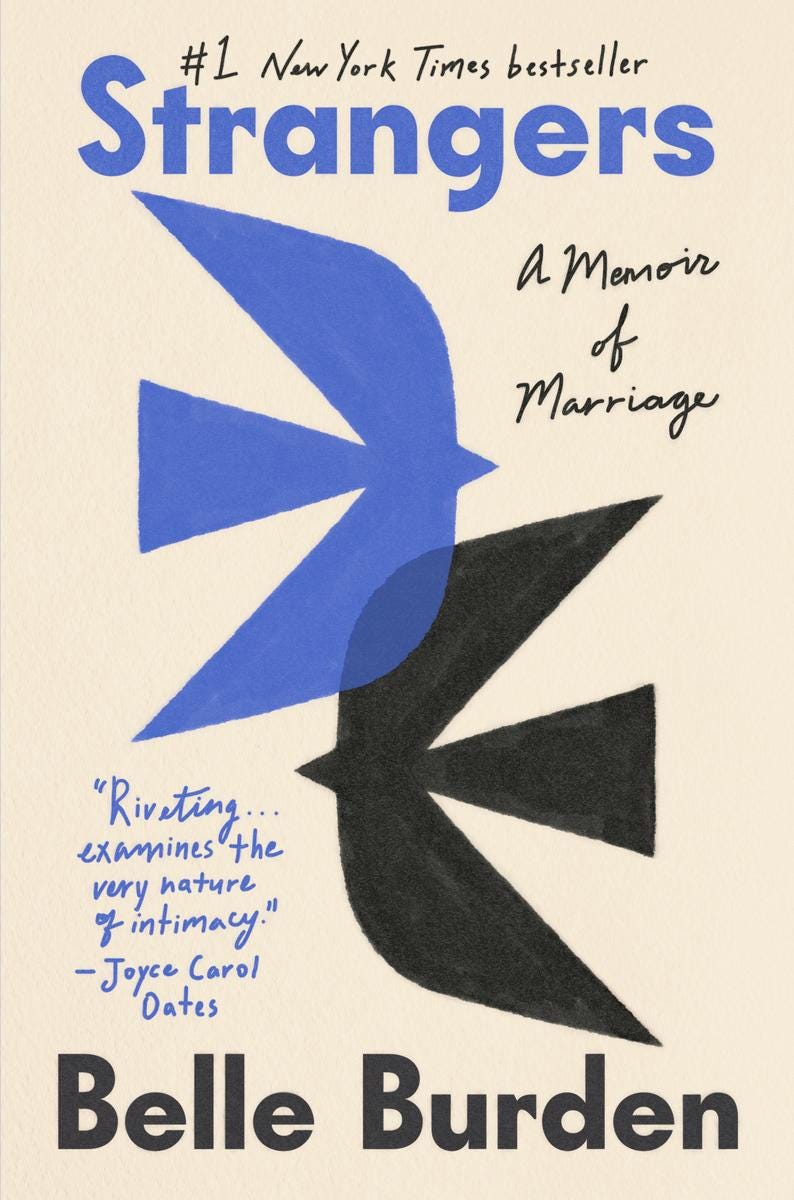
One of the things I appreciated about Belle’s story was her awareness of her privilege despite her pain. Belle is the granddaughter of Babe Paley, a 1940s socialite who was one of Truman Capote’s “Swans,” whose own betrayal was detailed in this Capote's Women: A True Story of Love, Betrayal, and a Swan Song for an Era. According to Belle, Babe’s fashionable and sociable genes were not passed down to her, who is more reserved than her grandmother.
Burden’s description of her pro bono immigration work, hints at a career woman who took a different path, one marked with both ambition and empathy for others. Belle describes struggling to complete a filing to make a case for her client’s special immigration status and how touched she was by the compassion her client’s mother had for Belle. “Our stories were not comparable; my challenges were mild compared to what she had survived. I felt ridiculous. But she didn’t seem to see it this way. She offered me empathy.”
In a conversation with Katie Couric, Belle remarked: “It felt essential to acknowledge this in the book: both my internal awareness of it and so that I could be a reliable narrator. But what I hope people come to see from my story is that money cannot protect anyone from heartbreak.” My opinion on how Belle deals with her privilege should come with a disclaimer. I’ve recommended this book to a lot of people and several have come back saying that they couldn’t get past her privilege and it colored their view of the book. If this might be you, then consider this a trigger warning.
What began as a Modern Love article and ended up as this best selling memoir, with appearances on Oprah and a movie deal in which Gwyneth Paltrow will portray her, is a real woman’s story. A story of pain and heartbreak and ultimately survival and triumph (see the bits above about Gwyneth, Oprah and Katie Couric), that I hope will inspire many others to tell their stories. Even the men.
From Belle’s story, our book club was particularly struck by the incredible care that her daughter showed her mother during this time. It was touching and painful to imagine her teenage daughter learning to cook the meals her father once did as a way of caring for her mother and her family. This may be not surprising, as women and girls are conditioned to care for others. Belle’s daughter’s instinct, or as one dear reader pushed me to realize more accurately, her learned behavior, was to protect her own mom and therefore her whole family. This is perhaps an explanation and precursor of what is now known as the “Marriage Benefit Imbalance,” which I first learned about in Gilbert’s All the Way to the River, referenced above.
The data is overwhelmingly compelling and shows how married women underperform their unmarried counterparts on practically every measure of well-being (physical health, mental health, longevity, wealth and happiness). Whereas married men outperform bachelors in all of those same measures. Married men live longer, are less likely to be depressed, less likely to have problems with drugs or alcohol and they even get an earnings boost (trying to resist inserting “wtaf” here). While this data may come as a shock, it may also not be surprising. Women give everything of themselves to their partners and their families, uplifting everyone in their orbit, often at their own expense. Seeing Belle’s daughter rise to the role of caretaker in this difficult time shows how we are pre-disposed to do this at a very young age.
I was most struck by some of the final pieces in Belle’s story. Again, no spoilers here, but Belle was criticized and doubted for telling her story in the New York Times. Strangers called her “a ‘rich bitch’ who ‘deserved to be left.’” She was gossiped about by those close to her, calling her a “Bad mother. A good mother is meant to protect her kids at all costs. A good mother would never call out her children’s father publicly.” For a mother who has dedicated her life to raising their kids, the moniker “bad mother” is about as bad as it gets.
It’s 2026 and we are silencing women for telling their story. What is inherent in the memoir genre (divorce or otherwise), is that as readers, we know that we are only getting one side of the story. It is our responsibility to understand that and to read with a critical eye. Belle acknowledges this in her Author’s Note: “This book is the story of my marriage, its ending and what happened afterward. It recounts events as accurately as I can remember them.”
Luckily, Belle found her own internal monologue that was louder than the critics:
“What if telling the story publicly, saying what happened to us, actually helps my kids? What if seeing their mother rise, seeing her claim her life, giving clarity to their experience, is the greater gift? Isn’t this possible too?”
I’m so grateful to Belle for telling her compelling story of love and loss and I hope women everywhere continue to find inspiration to find their voice, and maybe a room of their own to write down their stories.
*Another Ephron favorite is I Feel Bad About My Neck which is a must read for anyone, you guessed it, who feels badly about their neck.
I love this and now have add several of the books you suggested to my TBR list, growing ever longer (Heartburn, Strangers, You Could Make This Place Beautiful). The one thing I'll offer here is that I don't believe that women and girls are inherently good at or even interested in mothering/care labor, or as you said, "are natural caretakers." We're conditioned from a young age for this. We buy little girls baby dolls and play kitchens and little boys dinosaurs and Lego sets (this is obviously not true for everyone, but a general trend). We expect girls to participate in household chores more than their male counterparts (https://genderjusticeandopportunity.georgetown.edu/wp-content/uploads/2022/07/22_COPI_INDISPENSABLE_REPORT_FINAL-1.pdf). We're not predisposed to it - we're conditioned for it.
I love the way you've discussed Burden's bravery for telling her story and the challenges and reactions that have come from it (many seemingly sexist).
Separately, I haven't read an Ephron book yet! Which one should I read first? And second? :)